
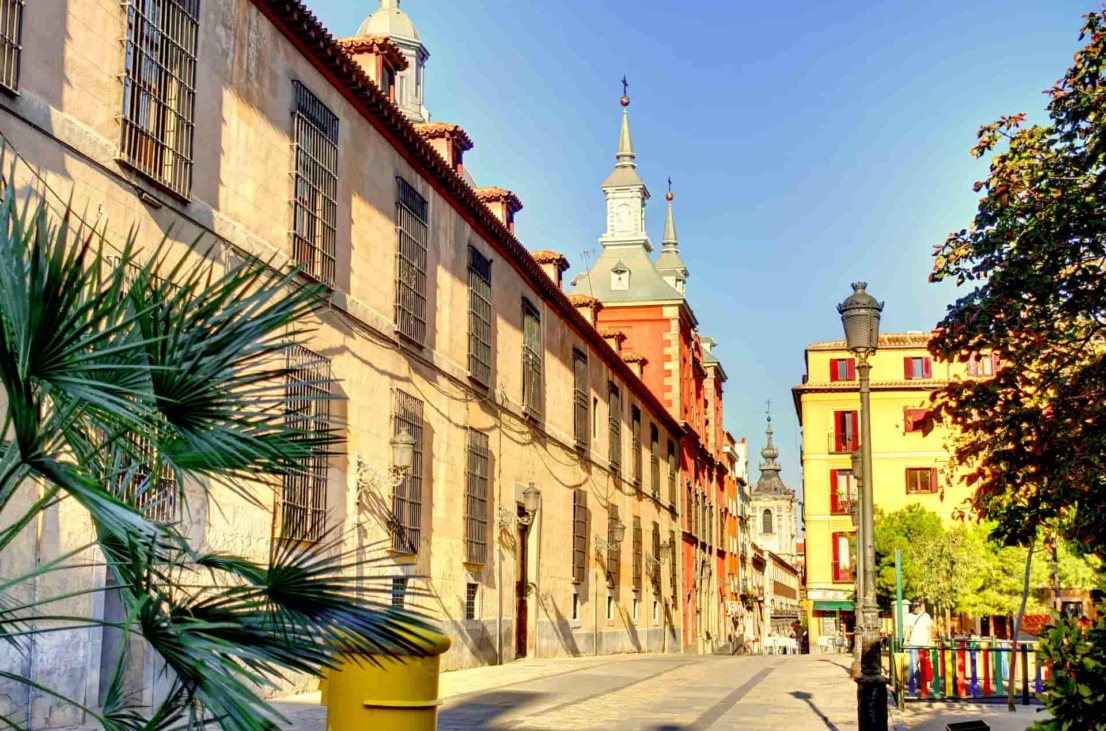
Barrio de las Letras is one of the most iconic areas in Madrid’s Centro district. Although it is administratively part of the Cortes neighborhood, its historical and cultural identity has turned it into a distinct space within Madrid’s collective imagination. Some of the greatest figures of Spain’s Golden Age lived here, and today its streets still reflect that literary legacy through theaters, museums, protected buildings, and a vibrant cultural life.
Walking through Barrio de las Letras is not simply strolling around the historic center—it means stepping into the setting where a fundamental part of world literature was written.
History and Origins of Barrio de las Letras
The origins of Barrio de las Letras date back to the 16th century, when Madrid was designated capital of the Spanish Monarchy in 1561 by King Philip II. The arrival of the royal court spurred urban expansion toward the Prado de los Jerónimos, an area that had previously consisted of orchards and farmland.
During the 16th and 17th centuries, numerous writers, playwrights, and poets settled here. Miguel de Cervantes, Lope de Vega, Francisco de Quevedo, Luis de Góngora, and Calderón de la Barca all lived in these streets. This concentration of literary talent gave rise to the popular name “Barrio de los Literatos,” which eventually evolved into Barrio de las Letras.
The development of theater played a decisive role. In what is now Plaza de Santa Ana stood the Corral del Príncipe, the origin of today’s Teatro Español, one of the oldest theaters in Europe with uninterrupted activity. Theater transformed the neighborhood into a creative and social hub during the Golden Age.
Calle de las Huertas, the neighborhood’s main artery, still features engraved fragments of literary works in its pavement, reinforcing its cultural identity.
Today, the area forms part of the “Landscape of Light,” declared a UNESCO World Heritage Site in 2021. Many of its buildings are also protected under Law 8/2023 on Cultural Heritage of the Community of Madrid, ensuring the preservation of its historic structure and urban character.
What to See in Barrio de las Letras
The neighborhood offers an exceptional concentration of cultural heritage within just a few blocks.
Plaza de Santa Ana is the heart of the area. Here you will find statues dedicated to Calderón de la Barca and Federico García Lorca, as well as the historic Teatro Español. It is the ideal starting point to explore the neighborhood.
- The Lope de Vega House-Museum, managed by the Community of Madrid, allows visitors to explore the home where the playwright spent his final years. Nearby stands the Convent of the Barefoot Trinitarians, where the remains of Miguel de Cervantes rest.
- The Church of San Sebastián, on Calle Atocha, preserves historical records linked to Golden Age literary figures. The Ateneo de Madrid, located on Calle del Prado, has been one of Spain’s leading intellectual debate centers for two centuries.
- Callejón del Gato, on Calle Álvarez Gato, is famous for its distorting mirrors, immortalized by Valle-Inclán in his “esperpento” aesthetic.
The neighborhood is located next to the “Golden Triangle of Art,” formed by the Prado Museum, the Reina Sofía Museum, and the Thyssen-Bornemisza Museum. This proximity strengthens its cultural importance within Madrid.
Plaza de las Cortes, presided over by the Spanish Congress of Deputies, marks the neighborhood’s northern boundary and connects it with the city’s institutional axis.
Transport and Connections
One of Barrio de las Letras’ main advantages is its excellent connectivity.
The Madrid Metro network offers several nearby stations:
- Sol (Lines 1, 2, and 3)
- Antón Martín (Line 1)
- Estación del Arte (Line 1)
- Sevilla (Line 2)
These connections allow easy access from anywhere in the city within minutes.
Atocha Station, the country’s main railway hub, is located within walking distance. High-speed trains and the Cercanías Renfe commuter network connect it with the entire metropolitan area.
The Municipal Transport Company (EMT) operates zero-emission bus lines that cross the Centro district, promoting sustainable mobility. Bicimad, the public electric bicycle system, has stations distributed throughout the area.
The neighborhood is part of a pedestrian-priority zone with traffic restrictions for private vehicles, creating a calm and accessible environment.
Plans and Activities in Barrio de las Letras
Barrio de las Letras offers year-round cultural programming.
The Mercado de las Ranas, organized by the Merchants’ Association, energizes Calle Huertas with periodic cultural and commercial activities. This event reinforces the neighborhood’s creative and artisanal character.
Teatro Español maintains a stable program of classical and contemporary plays. The Lope de Vega House-Museum offers free guided tours with prior reservation.
The Ateneo de Madrid organizes conferences, literary presentations, and public cultural cycles.
Literary routes promoted by the City Council allow visitors to explore locations linked to the Golden Age and understand the historical context of the neighborhood.
From a gastronomic perspective, the area preserves historic taverns alongside contemporary culinary proposals. The blend of tradition and modernity is part of its identity.
At night, the neighborhood maintains an active cultural atmosphere with live music, flamenco venues, and terraces located in historic buildings.
Types of Apartments: Prices and Information
Barrio de las Letras is integrated into the Cortes-Huertas area, one of the most valued zones in the Centro district.
The real estate offering is characterized by renovated historic buildings, many protected under regional heritage regulations. Properties often date from the late 19th or early 20th centuries, featuring balconies, high ceilings, and restored original elements.
According to data from the National Statistics Institute and the Association of Land Registrars, the average price per square meter in this area ranks among the highest in the Centro district. The rental market also reflects sustained demand, regulated by the Rental Reference Index prepared by the INE.
Property owners must comply with obligations such as the Building Evaluation Report for properties over 50 years old, as well as conservation regulations established under Law 8/2023 on Cultural Heritage.
The predominant property types include:
- Renovated apartments in classic buildings.
- Penthouses with terraces.
- Two- and three-bedroom homes oriented toward international residents.
- Properties designated for regulated temporary rentals.
Compared to other premium central areas, the neighborhood maintains slightly lower prices than Madrid’s traditional luxury district. If you would like to explore another of the capital’s most exclusive areas, you can consult our guide to the Salamanca district and compare the differences between both environments.
Barrio de las Letras combines history, heritage, and urban life in a compact space full of meaning. Living in or visiting this area means becoming part of Madrid’s literary memory, in a protected and dynamic setting that continues to evolve without losing its essence.