
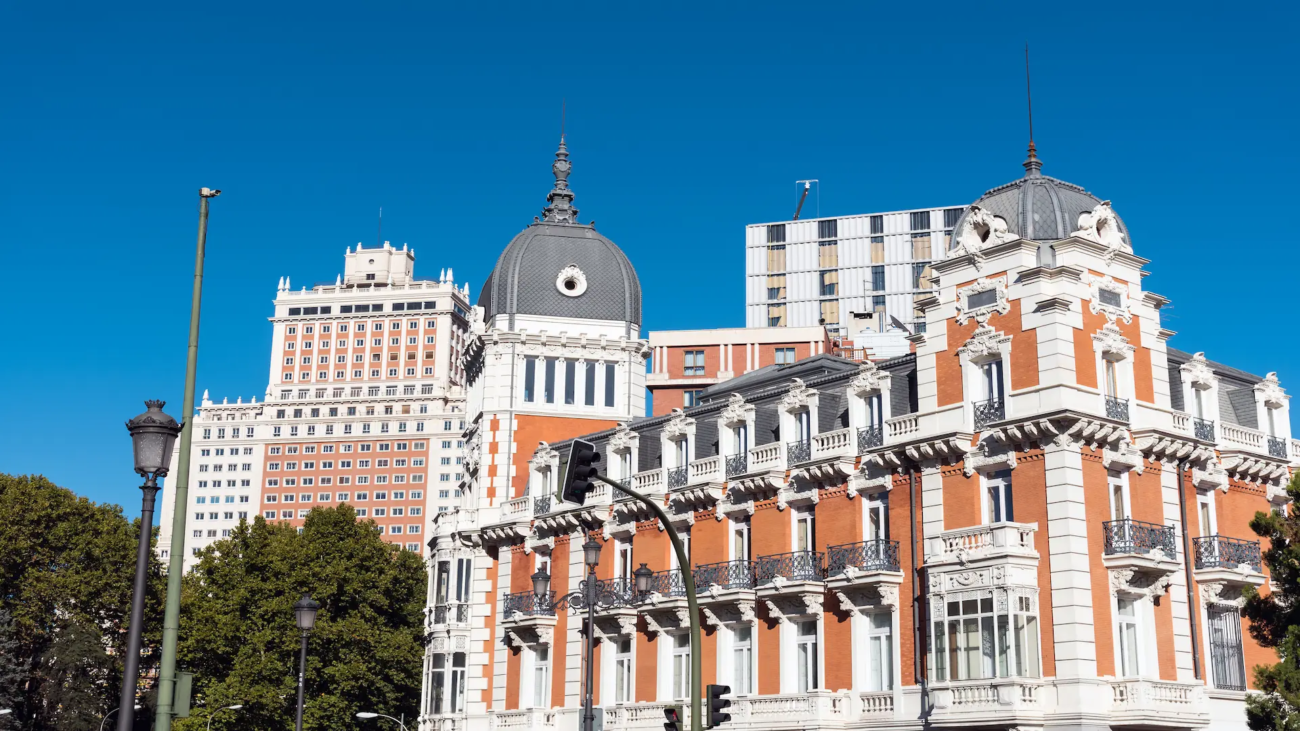
Modernist architecture in Madrid marks a decisive moment in the city’s urban evolution. At the turn of the 19th and 20th centuries, Madrid underwent an era of economic and territorial expansion that demanded new architectural responses. In this context, modernism emerged as a language capable of combining formal innovation, traditional construction techniques, and new social aspirations.
Madrid did not adopt modernism as a dominant style but instead integrated it selectively. This partial implementation explains the uniqueness of Madrid’s modernism, its coexistence with eclecticism, and its adaptation to an already established urban environment.
The Origin and Evolution of Madrid’s Modernism
Madrid’s modernism emerged during a period of profound urban transformation. Between the late 19th century and 1914, the city expanded rapidly with new roads and the consolidation of a financial and industrial bourgeoisie that sought to distinguish itself through architecture.
Unlike other Spanish hubs, modernism in Madrid developed under the strong influence of academicism. Architects incorporated organic and symbolic elements while still adhering to classical composition, resulting in a hybrid architecture where traditional structures were combined with nature-inspired decoration.
The evolution of the style can be divided into three phases: an initial phase marked by the introduction of modernism into decorative elements, a more developed phase between 1905 and 1914 when the language became more integrated, and a later stage where the style simplified and approached Art Deco and rationalism.
Key Modernist Buildings in Madrid
The modernist buildings in Madrid form a valuable urban heritage, both historically and artistically. Though dispersed, they help us understand how the style adapted to different uses and scales.
Palacio de Longoria, designed by José Grases Riera, is the epitome of Madrid’s modernism. Its undulating façade and organic design integrate structure and ornamentation into a unified architectural form.
Casa Gallardo, designed by Federico Arias Rey, stands out for its decorative richness, the use of floral reliefs, and slate-covered roofs influenced by French styles.
Cine Doré, now home to the Spanish Film Archive, represents late modernism applied to cultural spaces, showing a clear transition to more geometric forms.
Cementerio de la Almudena, partly designed by Francisco García Nava, showcases a symbolic side of modernism, where brick and arches acquire strong spiritual character.
These buildings demonstrate the typological diversity of Madrid’s modernism and its ability to adapt to the city’s urban fabric.
Neighborhoods with Modernist Architecture in Madrid
Neighborhoods with modernist architecture in Madrid reflect the social profile of those who propelled this style at the beginning of the 20th century.
Barrio de Salamanca, where modernism is integrated into high-end residential buildings, featuring brick facades, glazed bay windows, and restrained ornamentation.
La Guindalera and Colonia Madrid Moderno, with single-family homes that apply modernism to a garden city model.
Chamberí and Justicia, areas with high-quality architectural examples, where the environment around the Palacio de Longoria acts as an urban reference.
Historic Center and Barrio de las Letras, where modernism was used in commercial and hotel buildings as a distinguishing element.
This territorial distribution helps to understand Madrid’s modernism as a diverse and complementary urban phenomenon.
The Influence of Modernism on Contemporary Architecture and Design
The influence of modernism on today’s architecture in Madrid is especially visible in the rehabilitation of historic buildings. By 2025, many modernist buildings have become high-value real estate assets thanks to their architectural uniqueness.
The recovery of original elements such as moldings, stained glass, or wrought iron is combined with contemporary solutions for comfort and energy efficiency. This balance strengthens the appeal of rehabilitated housing compared to new builds.
In interior design, curved forms, natural materials, and craftsmanship directly connect with modernist principles. This sensitivity also interacts with later movements, such as brutalist architecture in Madrid, where organic forms reappear, reinterpreted through concrete and monumental structures.
Modernist architecture in Madrid constitutes a cultural and heritage-rich urban legacy. Its development was shaped by the capital’s academic and social context, resulting in a unique, eclectic, and adaptable style. From iconic buildings to lesser-known residential colonies, modernism has left a lasting imprint on the city.
Today, this heritage is fully integrated into contemporary life through rehabilitation, interior design, and real estate revaluation, establishing Madrid’s modernism as a key element of the city’s architectural identity.
Book Now on BizTrip