
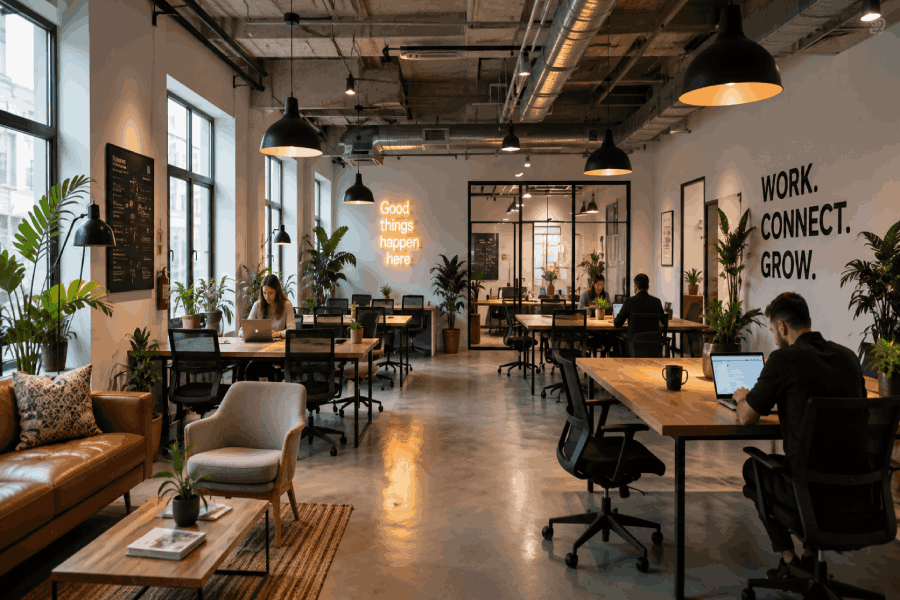
The workplace model has changed significantly in recent years, and many companies are now looking for more adaptable, efficient spaces designed for hybrid work dynamics. In this context, coworking in Madrid has become an increasingly popular alternative for both independent professionals and corporate teams.
Contract flexibility, lower operating costs, and the opportunity to work from strategic locations have driven the growth of flexible office spaces in the Spanish capital. In addition, Madrid has become one of the main destinations for startups, digital nomads, and international companies seeking to combine mobility, connectivity, and quality of life.
What Is Coworking and Why More Professionals Are Choosing It in Madrid
Coworking is a shared workspace model that allows professionals and companies to use flexible offices without taking on the costs and commitments of a traditional office.
Although it was initially more associated with freelancers and self-employed professionals, many companies now use coworking spaces for hybrid teams, temporary projects, or international expansion. This evolution has turned coworking into an increasingly common solution within Madrid’s business market.
Some of the reasons why more professionals are choosing this model include:
- Flexible contracts based on team needs.
- Strategic locations near financial districts and public transport.
- Access to included services such as internet, meeting rooms, and reception.
- Lower operating costs compared to traditional offices.
- Greater networking opportunities with other professionals.
In addition, the growth of remote work and hybrid models has increased the demand for spaces that allow people to work in a more dynamic and adaptable way.
What to Consider Before Choosing a Coworking Space in Madrid
Before choosing a coworking space in Madrid, it is important to analyze aspects such as location, connectivity, flexibility of use, and included services. Not all spaces meet the same needs, and many companies currently prioritize environments prepared for hybrid work, corporate meetings, and employee well-being.
Accessibility is one of the most important factors. Working close to public transport stations or business areas reduces commuting times and improves the daily experience of teams.
It is also worth evaluating aspects such as:
- Availability of private offices and meeting rooms: essential for hybrid teams and corporate meetings.
- 24/7 access and flexible schedules: especially useful for international professionals and companies with dynamic working hours.
- Quality of connectivity and workspaces: strong internet connections and comfortable environments improve productivity.
- Additional services such as restaurants, gyms, or events: they add value and improve the work experience.
- Design and comfort of the workspace: natural lighting and common areas directly influence employee well-being.
Madnum: An Example of Flexible Coworking in Madrid
Among the new coworking concepts in Madrid, spaces such as Madnum stand out for combining flexible offices, premium services, and a strategic location in the Méndez Álvaro area.
This complex embraces a more modern workspace model by integrating offices, coworking areas, restaurants, and common spaces designed to improve the daily experience of professionals and companies.
In addition, spaces such as Utopicus Madnum provide access to offices with natural light, meeting rooms, a gym, an auditorium, and areas prepared for collaborative work — all within a well-connected environment designed for hybrid work dynamics.
Benefits of Coworking for Professionals and Companies
The main advantage of coworking is the ability to access fully equipped professional spaces without taking on the fixed costs of a traditional office.
Companies can adapt the size of the space according to team growth or project requirements, while professionals benefit from greater flexibility and access to services included within a single monthly fee.
Some of the most notable benefits of coworking include:
- Greater contractual flexibility for companies and freelancers.
- Reduced operating and maintenance costs.
- Spaces prepared for remote work and hybrid meetings.
- Access to networking opportunities and professional communities.
- Better balance between mobility and in-person work.
This model is also particularly attractive for international professionals, startups, and remote workers looking to settle temporarily in Madrid without making major upfront investments.
The Importance of Combining Accommodation and Workspaces
Professional mobility and hybrid work have increased the demand for solutions that integrate accommodation and workspaces within the same experience.
Many relocated professionals need to work from Madrid for weeks or months and are looking for more comfortable and flexible alternatives that allow them to combine temporary housing and coworking easily. This integration helps reduce daily commuting, improve productivity, and create a more balanced routine during their stay.
In addition, having spaces designed for remote work improves the experience for both independent professionals and temporarily relocated corporate teams. It also simplifies operational management for companies that need to coordinate accommodation and workspaces within the same environment.
In this context, specialized solutions such as BizTrip help companies and professionals manage flexible accommodations adapted to new ways of working and corporate mobility. Combining temporary housing with coworking spaces creates a more efficient, comfortable, and modern experience aligned with today’s hybrid work needs.