
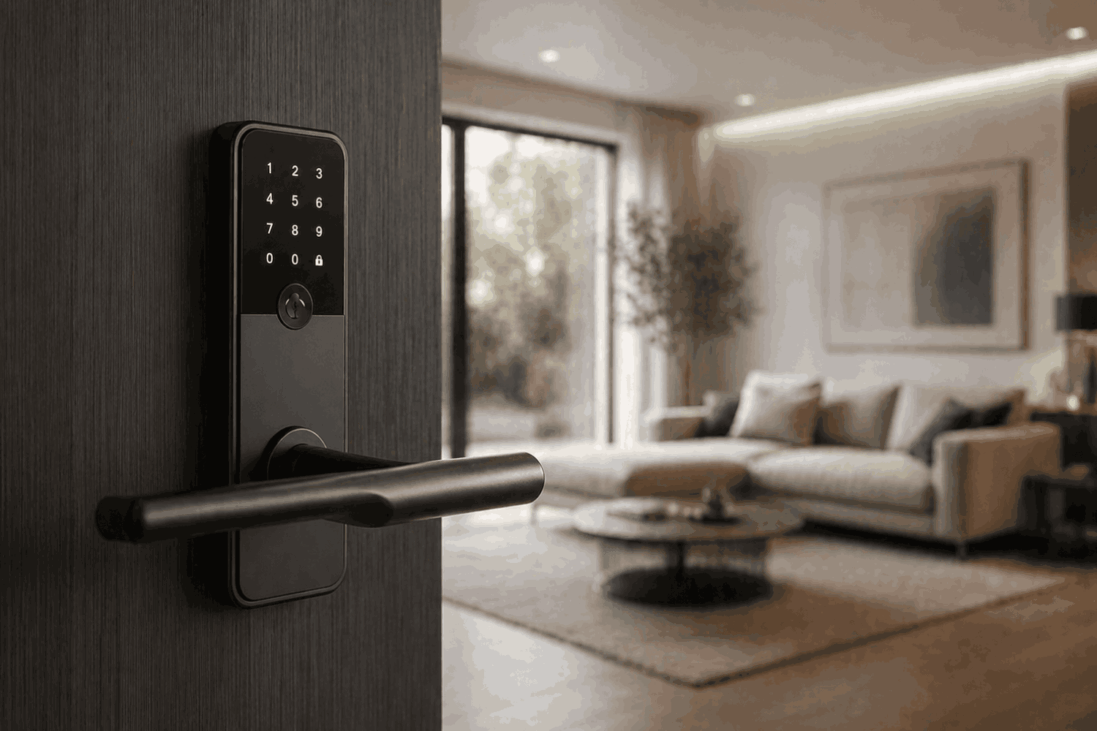
The smart lock has become a key feature in short- and medium-term rentals. It is not just a technological improvement, but a tool that meets a real need: managing access in a flexible, secure and frictionless way.
The growth of flexible rentals and the constant mobility of guests have driven the use of keyless systems. In this context, digitising access to the property allows for optimised operations and improves the guest experience from the very first moment. It is also a safer option for property owners as it allows for both remote access and locking, making the system ideal for avoiding any issues with occupancy or non-payment.
What is a smart lock?
A smart lock is an electronic system that allows a door to be opened and closed without the need for a traditional physical key. It works using digital credentials, such as PIN codes, mobile apps or cards.
This type of technology combines mechanical elements with connectivity. It integrates hardware and software to manage access remotely and in a controlled manner.
There are different types depending on how they are installed. Some are fitted over the existing lock, whilst others completely replace the system. The choice depends on the use and the type of property.
The aim is clear: to allow secure access without the need for physical contact. This is particularly useful in situations such as short-term rentals, where there is a constant turnover of guests.
How does a smart lock work in rentals?
The operation of a smart lock is directly linked to rental management systems.
- The booking is confirmed: When the guest completes the booking, the system generates a temporary digital access code linked to the dates of the stay.
- Access is sent to the guest: This access can be sent as a code or digital key before arrival.
- Contactless check-in: The guest can enter the property without needing to meet anyone in person, making the process much smoother.
- Access only works during the stay: The lock is activated within the booked period, which improves security and control.
- Permissions are created for other uses: Access can also be granted for cleaning or maintenance, limited to specific times.
- Manual administration is reduced: This system eliminates the need to hand over physical keys, reduces errors and allows for better organisation of access.
Overall, the smart lock simplifies day-to-day operations and provides greater control in rental properties.
Benefits of a digital lock
The implementation of a digital lock offers both operational and financial benefits:
- Improves daily efficiency: It eliminates the physical handover of keys, reducing the time and costs associated with travel or waiting.
- Makes it easier for guests to enter: Allows access to the property at any time, without relying on opening hours or third parties.
- Enhances security: Access is temporary and revocable, preventing issues arising from key duplication or loss.
- Simplifies operational management: Allows multiple access points to be managed from a single platform, which is essential when managing several properties.
- It promotes business scalability: With a reduced operational burden, it is possible to manage more properties without increasing resources.
In this regard, at Biztrip we have been working with this type of solution for some time, pioneering the installation of smart locks in rental properties. This experience has allowed us to refine the system through real-world use, improving both security and access reliability. As a result, we now have a more robust model, ready to adapt to the needs of each property and offer safer and more efficient management.
Digital key or physical key
The choice between a digital key and a physical key reflects two different ways of managing access to a rental property. The physical key remains a simple and familiar option, with the advantage that it does not rely on batteries, a connection or apps. However, in properties with high turnover, this can lead to more issues, particularly due to the difficulty in tracking how many copies exist or who retains them after each stay. This lack of traceability can become both an operational and a security issue.
In contrast, the digital key offers a much more flexible model. It allows you to generate temporary access codes that can be revoked instantly and tailored to each booking or user profile, whether it be a guest, cleaning staff or maintenance personnel. Furthermore, they offer greater control over day-to-day operations, as they centralise access management on a single platform and make it easier to track access. This is particularly useful in short- or medium-stay accommodation, properties with a constant flow of arrivals and departures, where simplifying processes makes a real difference.
That does not mean the digital system is without its limitations. As it relies on batteries, connectivity or technical configuration, it is advisable to have backup solutions in place to prevent occasional incidents. For this reason, many property owners opt for hybrid systems, which combine the advantages of digital access with a physical security alternative. This approach offers greater convenience, control and efficiency, without sacrificing an additional means of access when the situation requires it.
In this sense, the smart lock not only replaces the traditional key, but completely changes the way access to the property is managed. It gives guests greater autonomy, reduces the operational burden and improves security – three aspects that are increasingly valued in today’s rental market.